
Ghaf Trees Dubai: Benefits, Care, and Landscaping Ideas
Dubai’s hot climate makes tree selection an important part of landscape design, and homeowners looking for attractive trees that can genuinely handle heat, strong sunlight, and dry conditions often turn to native and drought-tolerant species. Ghaf Trees Dubai are an excellent choice for suitable villa gardens, large landscapes, parks, and outdoor spaces where a strong native character is desired. The Ghaf tree, scientifically Prosopis cineraria, is an important tree in the UAE and is well known for its ability to survive challenging desert conditions.
With its spreading canopy, distinctive form, and strong connection to the UAE’s natural heritage, the Ghaf works in both traditional and contemporary landscape designs. The tree has a special place in the UAE’s environment and culture, well adapted to arid regions and able to survive where many other species would struggle, which is exactly what makes it so interesting to landscape designers building genuinely sustainable outdoor spaces.
Why Ghaf Trees Matter for Dubai Landscapes
Ghaf Trees Dubai bring good tolerance to heat and drought, a genuine ability to provide shade, an attractive natural form, and a strong connection to the local landscape, all while needing relatively little water once established. That said, choosing a Ghaf should still be based on the site’s available space, soil conditions, irrigation setup, and overall landscape design rather than on reputation alone.
Benefits of Ghaf Trees Dubai Homeowners Can Rely On
When properly positioned, a Ghaf tree provides several genuine benefits to a villa landscape. Its spreading canopy is one of its biggest advantages: in a large garden, a mature specimen can create a valuably shaded area for outdoor seating, garden benches, dining spaces, walking paths, or a quiet corner to relax, making a well-placed Ghaf both a landscape feature and a functional source of shade.
Dubai’s extremely hot summers and strong sunlight make plant selection critical, and the Ghaf is naturally adapted to exactly these arid conditions, making it a genuinely resilient choice for a landscape that also reflects the natural character of the UAE. Once established, it tolerates dry conditions well — though drought tolerance does not mean a newly planted tree can be left without water. During establishment it needs appropriate irrigation to encourage healthy root development, and only once it is settled in can watering be gradually reduced depending on the site and the wider landscape management plan.
Using native or regionally appropriate plants also gives a landscape a stronger sense of place. Rather than a garden that looks entirely tropical or imported, Ghaf trees introduce a distinctive UAE-inspired character, and they combine particularly well with gravel, natural stone, desert-style planting, Agave, ornamental grasses, Date Palms, native shrubs, and contemporary paving.
Ghaf Trees for Modern Villa Landscaping
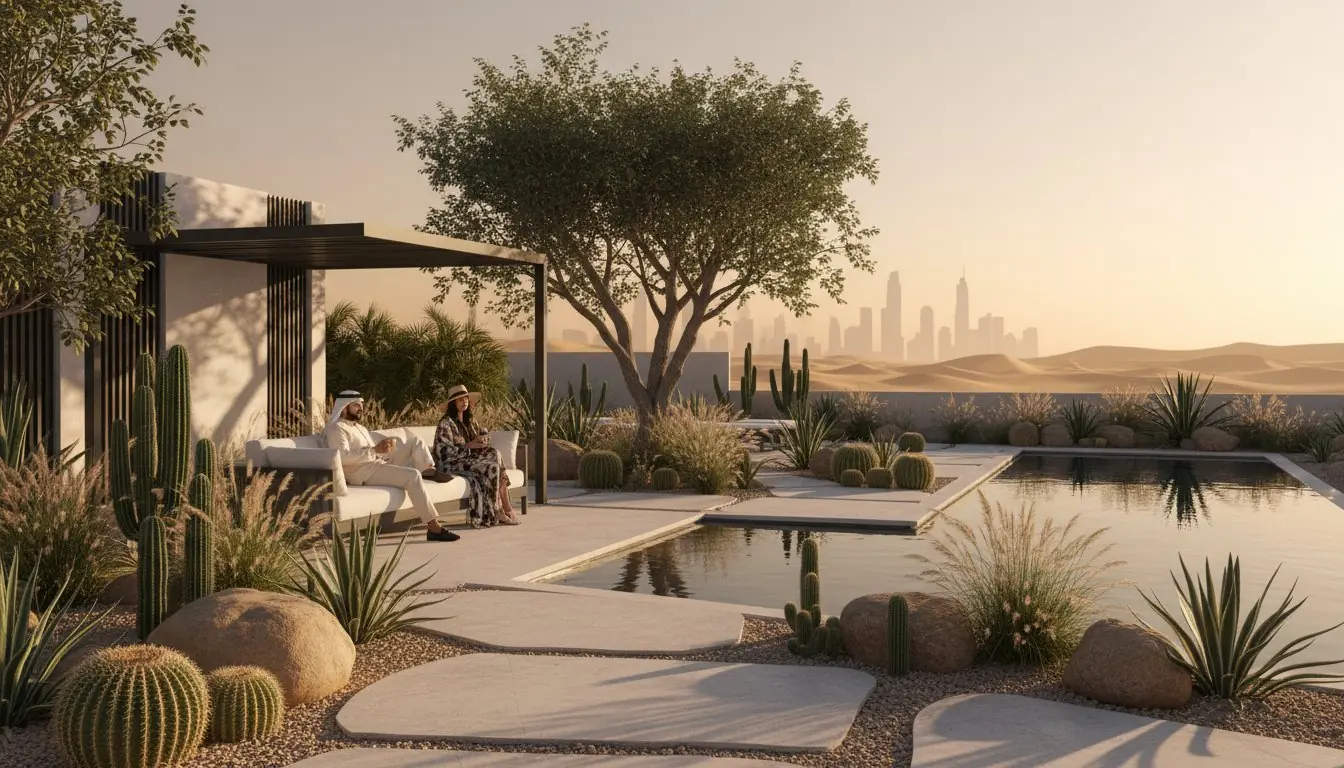
A Ghaf tree does not have to stay confined to traditional desert landscapes. With thoughtful design, it becomes a genuine focal point in a modern villa garden — a large specimen planted within a spacious gravel area, surrounded by contemporary paving, low-maintenance shrubs and grasses, large-format stepping stones, and subtle uplighting directed at the canopy, creates a clean, contemporary composition while letting the Ghaf remain the main visual feature.
Where to Plant Ghaf Trees Dubai Gardens Actually Have Room For
Location is one of the most important considerations when planning Ghaf Trees Dubai for a villa landscape. Because the tree develops a substantial canopy over time, it should never be planted in a restricted bed without accounting for its mature size. Large villa gardens, open lawn areas, garden corners, large planting beds, driveway landscapes, public landscape areas, parks, and spacious outdoor seating areas are all suitable locations, while planting too close to buildings, underground services, narrow pathways, or other structures without a professional assessment should be avoided.
Ghaf Trees and Outdoor Seating Areas
One of the most creative uses of Ghaf Trees Dubai landscapes is designing an outdoor seating area beneath or near the tree. Picture a spacious garden with a mature Ghaf, a circular gravel bed, a curved bench, natural stone paving, low planting, and warm landscape lighting — the tree becomes a natural focal point while providing shade and a genuinely comfortable garden atmosphere, an approach that works especially well for large UAE villas built for relaxation and entertaining.
Ghaf Trees Compared With Other Shade Trees in Dubai
Several trees can provide shade in Dubai, but each brings something different. The Ghaf offers native character alongside shade and drought tolerance; Plumeria contributes flowers and attractive branching; Delonix regia offers a broad canopy with seasonal colour; Olive trees bring a Mediterranean appearance; Neem provides dense shade with fast growth; and Date Palms add a distinctly UAE-inspired vertical feature. The right choice depends on garden size, design style, desired shade, maintenance requirements, and irrigation availability, and for a large villa landscape, combining a few different species often creates a more layered, visually interesting garden than relying on just one.
How to Care for Ghaf Trees in Dubai
Although the Ghaf is resilient, proper maintenance still matters. Newly planted trees need consistent irrigation during establishment, ideally delivered directly to the root zone through a properly designed system, while overwatering should be avoided and irrigation adjusted according to soil conditions, weather, tree maturity, and the wider landscape plan.
Good soil preparation helps newly planted trees establish successfully — assessing existing soil quality, drainage, structure, salinity, planting depth, and root-zone conditions before planting, and improving the soil where necessary, encourages healthier growth. Pruning should focus on removing dead, damaged, or weak growth and unwanted low branches, while avoiding unnecessary heavy pruning that forces the tree into an unnatural shape. Established Ghaf trees generally need less intensive fertilization than newly planted specimens; a suitable program should be based on the tree’s actual condition and soil requirements rather than applying fertilizer on a fixed schedule.
Ghaf Trees for Sustainable Landscaping
Sustainable landscaping is becoming increasingly important in Dubai, and choosing plants suited to the local climate helps reduce unnecessary water consumption and long-term maintenance. Ghaf Trees Dubai contribute directly to this approach, since the species is naturally adapted to arid environments. A sustainable villa landscape can combine Ghaf trees with efficient drip irrigation, drought-tolerant shrubs, decorative gravel, permeable paving, native and adapted plants, automated irrigation controls, and appropriate soil preparation — the goal being not simply to use less water, but to design the whole landscape around the local environment.
Common Mistakes When Planting Ghaf Trees
Even a resilient tree can struggle if planted incorrectly. The most common mistakes are planting too close to buildings without accounting for mature size, poor irrigation during establishment, incorrect planting depth that can negatively affect tree health, ignoring challenging local soil conditions, excessive pruning that fights the tree’s natural form, and choosing a specimen too large for the available long-term space. Avoiding these mistakes is usually simply a matter of proper planning before the tree goes into the ground.
Combining Ghaf Trees With Other Plants
A Ghaf tree becomes even more attractive when surrounded by carefully selected supporting plants. For a modern UAE villa, Agave, Lantana, Bougainvillea, ornamental grasses, Liriope, Yucca, Date Palms, and low-growing shrubs all combine well, using different plant heights to build layers — the Ghaf forming the upper canopy, medium-height shrubs the middle layer, and low groundcover or gravel completing the foreground — for a balanced landscape that never looks overcrowded.
Ghaf Trees for Large Villa Gardens
Large villas often have enough outdoor space to accommodate a mature feature tree, and in these landscapes a Ghaf works as a genuine focal point rather than simply a boundary tree. A large circular planting area with a Ghaf at the centre, surrounded by decorative gravel and low planting, with a pathway connecting it to the villa entrance, swimming pool, pergola, or outdoor seating area, creates a strong visual connection between different parts of the garden.
Sourcing Plants and Getting Professional Help
When planning a villa landscape, selecting good-quality plants and suitable garden materials matters. Souq Garden is worth considering when sourcing plants, trees, pots, and other gardening materials for a landscape project, and for larger projects it is worth planning the planting layout before purchasing trees, which helps determine the correct number of plants, spacing, sizes, and locations. Our landscape design service can help translate a Ghaf Trees Dubai concept into a complete site plan, from tree placement through irrigation and hardscape.
Final Thoughts
Ghaf Trees Dubai offer a genuine opportunity to bring a distinctive UAE character into modern landscape design. Their ability to tolerate challenging desert conditions, paired with an attractive natural form and a shade-producing canopy, makes them worth considering for suitable villa gardens and larger outdoor spaces. The key to success is proper planning — the available space, soil, irrigation, mature tree size, surrounding plants, and overall garden design should all be considered before planting. Whether designing a new villa landscape or renovating an existing garden, a well-positioned Ghaf tree can become a long-term feature that connects the landscape with the natural character of the UAE.
Planning a Ghaf Trees Dubai Project With Confidence
Homeowners weighing up Ghaf Trees Dubai against other shade species should remember that a Ghaf typically takes several years to reach its full canopy, so it rewards early, careful placement more than any other tree on this list. Starting with a clear site plan for Ghaf Trees Dubai avoids costly repositioning later, once the root system is established and moving the tree is no longer realistic.
A Ghaf Trees Dubai planting also pairs naturally with a wider water-wise garden strategy. Because the species needs so little irrigation once mature, the water saved can often be redirected toward a smaller, more manageable flowering area elsewhere in the villa garden, giving homeowners both a native feature tree and room for colour without raising the overall water bill.
Frequently Asked Questions
What are Ghaf trees?
Ghaf trees are Prosopis cineraria, a species native to arid regions of the Arabian Peninsula and parts of South Asia, well adapted to dry environments.
Are Ghaf Trees Dubai gardens can genuinely use?
Yes. Ghaf Trees Dubai can suit spacious gardens and landscapes when the planting location, soil, irrigation, and mature size are properly considered.
Do Ghaf trees need a lot of water?
Established Ghaf trees are adapted to dry conditions and tolerate drought well, though newly planted trees still need appropriate irrigation during establishment.
Are Ghaf trees good for shade?
Yes. Their spreading canopy provides useful shade, making them suitable for larger gardens, outdoor seating areas, and open landscapes.
Can I plant a Ghaf tree in a small villa garden?
It depends on the available space and planned location. Because the tree develops a substantial canopy, a professional assessment is recommended before planting it in a restricted area.
How can Ghaf trees be used in modern landscaping?
Ghaf trees work well as feature trees in gravel gardens, lawn areas, seating spaces, contemporary villa landscapes, and UAE-inspired landscape designs.
Are Ghaf trees low maintenance?
Once established, Ghaf trees are relatively resilient, though they still need appropriate irrigation, occasional pruning, soil management, and general landscape maintenance.
